Allergy Test
Allergy testing for children and adults by an experienced dermatologist and allergist at Derma Medical Clinic in Zurich - Shilcity
Allergy Test
Chronische Abszesse und schmerzhafte Knoten durch erfahrenen Hautarzt abklären und behandeln in der Derma Medical Clinic in Zürich - Sihlcity
If an allergy is suspected: Diagnosis of skin rash, hay fever, shortness of breath, persistent cough, or digestive problems through modern allergy diagnostics – using a skin allergy test (prick test), patch test (epicutaneous test), or blood test
Examinations
Prick test
Epicutaneous test
Blood test
Procedure
Initial consultation + test selection
Duration
between 20 minutes and 72h
Allergy Testing at a Glance
Who can benefit from an allergy test?
Allergy testing is particularly recommended if you…
- suffer from recurrent skin reactions such as eczema, itching, or hives
- develop cough, shortness of breath, or gastrointestinal problems after eating, during pollen season, or in contact with animal dander
- suspect that your symptoms might be related to cosmetics, metals, cleaning products, or care products
- have previously had an unusually strong reaction to medication, latex, or insect stings
- are unsure what exactly the triggers are and desire thorough diagnostics
- suspect allergies, neurodermatitis, or food intolerances in your child and are seeking clarity

Who can benefit from an allergy test?
Allergy testing is particularly recommended if you…
- suffer from recurrent skin reactions such as eczema, itching, or hives
- develop cough, shortness of breath, or gastrointestinal problems after eating, during pollen season, or in contact with animal dander
- suspect that your symptoms might be related to cosmetics, metals, cleaning products, or care products
- have previously had an unusually strong reaction to medication, latex, or insect stings
- are unsure what exactly the triggers are and desire thorough diagnostics
- suspect allergies, neurodermatitis, or food intolerances in your child and are seeking clarity
Treatment
Skin Allergy Test – Prick Test
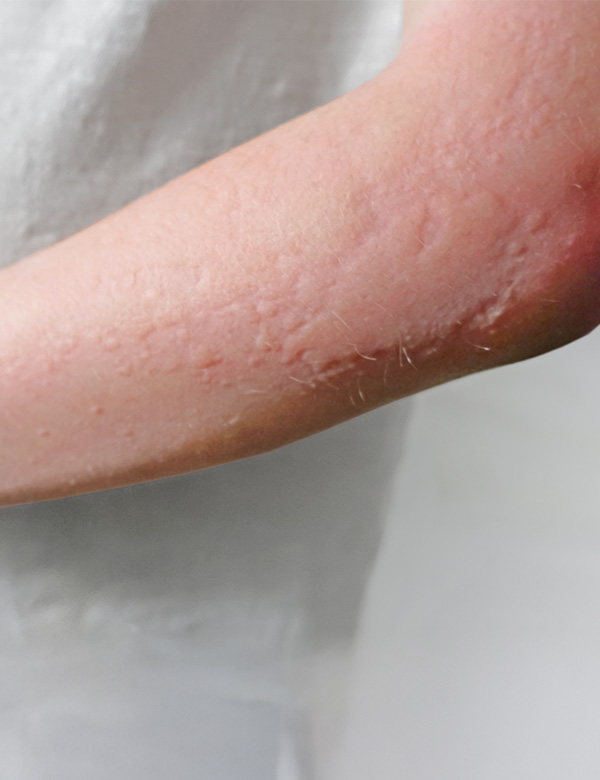
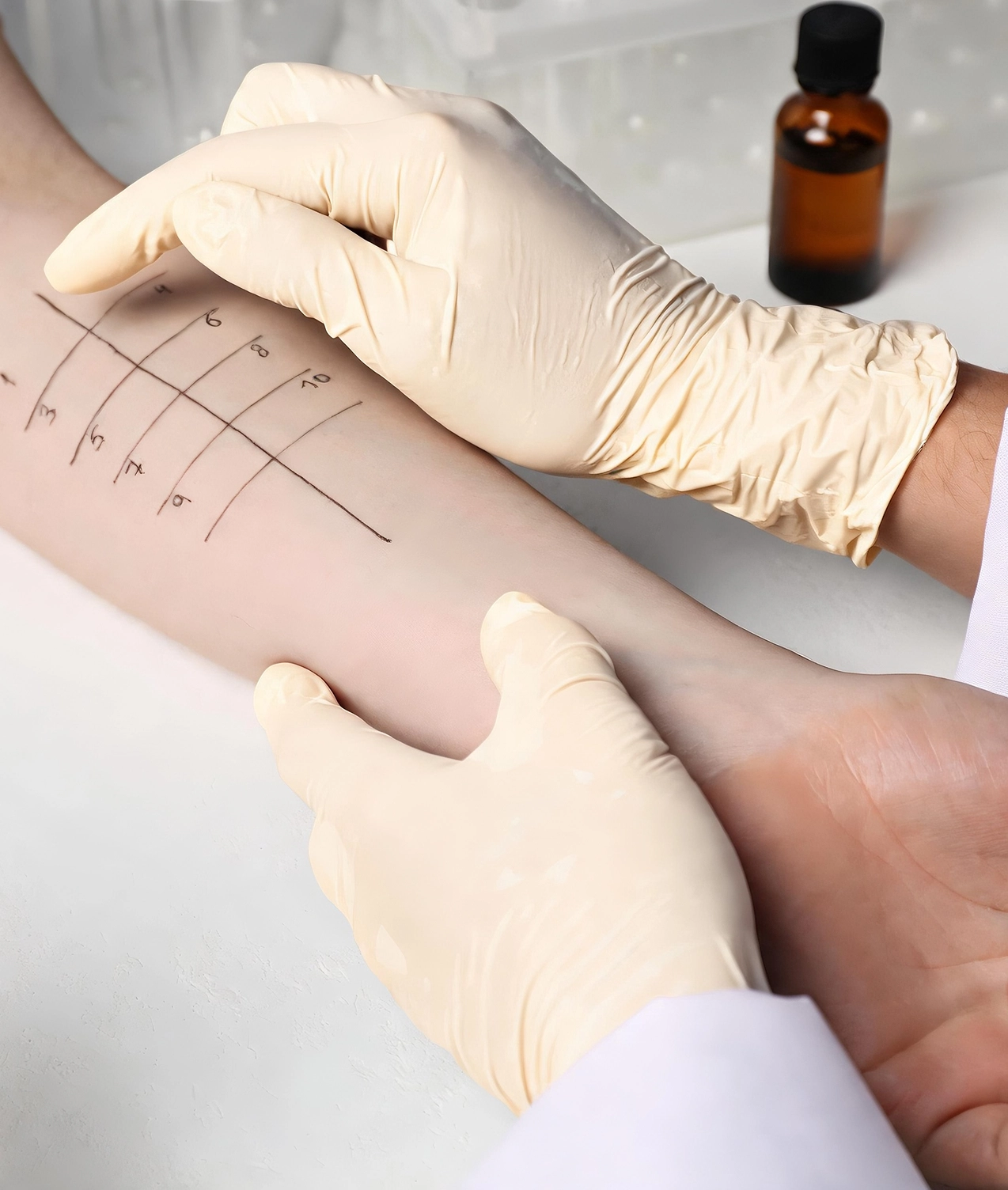
The prick test is performed on the skin of the forearm. Small drops of various test solutions are applied, and the skin is lightly pricked. If the body reacts within 15–20 minutes with redness or hives, an immediate-type allergy is likely present.
- Suitable for pollen allergy, house dust mites, animal dander, or certain foods. Also well-suited for children.
Patch Test for Contact Allergies – Epicutaneous Test
For the epicutaneous test, test patches with various substances are applied to the back. These remain on the skin for 48 hours, after which the first check is performed. A second reading takes place on day 3.
- Suitable for allergic reactions to cosmetics, metals (e.g., nickel), fragrances, cleaning products orclothing. Also possible in childhood.
Blood Test – Allergy Test from Blood
The blood test measures so-called IgE antibodies, which are produced in the body during allergic reactions. It is used when a skin test is not possible or when supplementary information is needed.
- Helpful for unclear symptoms, food allergies, or to confirm other test results. Also well-suited for children.
What happens next?
After evaluation, you will receive concrete recommendations for allergen avoidance, possibly medication for relief, or, for certain allergies, information on hyposensitization.
How does allergy testing work?
Initial Consultation & Test Selection
In the initial consultation, we clarify what symptoms exist, when they occur, and whether there are any known allergies. Based on this, we decide which allergy test is appropriate.
Allergy Test
Depending on the suspicion, we perform a prick test (allergy triggers on lightly pricked skin) or a blood test. The goal is to identify the trigger(s) as clearly as possible.
Skin Test – Prick Test
The skin on the forearm is moistened with small drops of allergy-triggering substances and lightly pricked. The reaction usually appears after 15 to 20 minutes. The test is short, well-tolerated, and also suitable for children.
Patch Test – Epicutaneous Test
Test patches with various substances are applied to the back. These remain there for 48 hours. Reactions are checked on days 2 and 3.
Blood Test
If a skin test is not possible or supplementary information is needed, we take a blood sample from a vein in the arm. The test measures whether the immune system overreacts to certain allergens.

At Derma Medical Clinic, allergy treatment is provided by Dr. Markus Dendorfer, a specialist in dermatology and a specialized allergist.
He has many years of experience in the diagnosis and treatment of allergic diseases, from hay fever to complex allergic reactions.

Dr. med. Markus Dendorfer
Board-certified Specialist in Dermatology & Venereology FMH
What you can expect from us
Recognizing Allergies
Many allergic symptoms manifest on the skin, sometimes with a delay or atypically. As a dermatological practice with a focus on allergology, we combine both in diagnostics.
Child-friendly Diagnostics & Support
With children, we also proceed carefully, explain things in an age-appropriate manner, and support families with clear and empathetic guidance throughout the process.
Tailored Advice
Allergies often do not occur in isolation. If various triggers are involved, we consider their interplay and provide recommendations that can be practically implemented in daily life, e.g., regarding diet or care products.
Everything under one roof
You receive diagnosis, medical treatment, and cosmetic support in one place. This means you have fixed contact persons, short distances, and coordinated care, from the initial examination to aftercare.
Do you suspect an allergy but don't know the trigger?
Book an appointment for allergy testing at Derma Medical Clinic in Zurich – Sihlcity now.
FAQ – Frequently Asked Questions about Allergy Tests
What is a skin allergy test (prick test)?
The prick test is a quick, proven skin test for diagnosing immediate-type allergies – e.g., pollen allergy, house dust mite allergy, or animal dander allergy. Small drops with diluted allergens are applied to the forearm, and the skin is lightly pricked. If a reaction such as redness or a wheal appears within 15–20 minutes, the test result is positive.
When is a patch test (epicutaneous test) performed?
The epicutaneous test – also known as a patch test – is used for contact allergies, such as reactions to nickel, fragrances, or cosmetics. Test patches with typical triggers are applied to the back and checked after 48 and 72 hours. The test detects delayed-onset allergies.
What is a blood allergy test (IgE test)?
The allergy blood test measures so-called IgE antibodies, which can be elevated in the blood during allergies. It helps diagnose food allergies, allergic asthma, or sometimes insect venom allergies, especially when a skin test is not possible, for example, in cases of neurodermatitis or in children.
Which allergy test is right for me?
That depends on your symptoms:
- For immediate reactions like sneezing, shortness of breath, or itching: usually a prick test or IgE blood test
- For delayed skin reactions like eczema: epicutaneous test
Your doctor will make the selection after the consultation and reviewing your medical history.
How reliable are allergy tests at the dermatologist?
Allergy tests provide important clues but are not the sole diagnostic tool. A positive test without symptoms does not require treatment. The decisive factor is always the medical assessment in conjunction with your symptoms.
What do I need to consider before an allergy test?
- Do not take anti-allergic medication 3 days before a skin test
- The test site must not be irritated or inflamed
- Do not use new cosmetics before a patch test
- Blood test: no special preparations needed
Is an allergy test painful or dangerous?
No, the tests are generally almost painless. With the skin test (prick test), there may be brief itching, and with the patch test (epicutaneous test), slight redness may occur. Blood draws are well-tolerated. Severe reactions are rare; all tests are performed under medical supervision.
What happens if the allergy test is positive?
Then we will discuss the next steps together, e.g., allergen avoidance, medication, or hyposensitization. The goal is to alleviate symptoms long-term and prevent secondary diseases.
What is the difference between desensitization and hyposensitization?
In medical terminology, desensitization and hyposensitization mean the same thing: a specific immunotherapy in which the body is gradually accustomed to an allergen. The goal is to reduce or completely prevent the allergic reaction in the long term. The term “hyposensitization” is more commonly used professionally, while “desensitization” is more common in everyday language.
Who performs allergy tests?
At Derma Medical Clinic in Zurich – Sihlcity, all allergy tests are performed by an experienced dermatologist with additional training in allergology, offering modern diagnostics and therapy advice.