Polynucleotides for Hair Growth
Regenerative treatment for thinning hair and early hair loss – at Derma Medical Clinic in Zurich Sihlcity.


Polynucleotides for Hair Growth
Polynucleotides for Hair Growth at Derma Medical Clinic in Zurich – Sihlcity
When hair becomes visibly thinner
The parting becomes wider, the scalp shows through more and the hair loses density. With androgenetic hair loss, the hair becomes finer over time. With polynucleotides, we can improve the nutrient supply to damaged hair follicles and promote healthy hair growth. The treatment is carried out on an outpatient basis at our practice in Zurich.
Treatment Options
Procedure
Examinations
Duration
Socially presentable after treatment
Sports, Swimming, Sauna
Cost
Polynucleotides strengthen the hair follicles
Polynucleotides are biostimulating proteins that also occur naturally in our body. They have a cell-regenerating and healing-promoting effect on hair and scalp. Introduced into the scalp, they create a favourable environment for the existing hair follicles and can support the growth of stronger hair.

Causes of hair loss
If the hair becomes thinner and sparse areas appear, this is often hereditary. Other possible causes: illnesses, side effects of medication, hormonal changes, chronic stress or a nutrient deficiency. Before every treatment, our doctors clarify which form of hair loss is present and whether polynucleotides are suitable for effective treatment.
Polynucleotides for Hair Growth at a Glance
When an assessment makes sense
- When your hair becomes thinner
- When your parting looks wider
- When your scalp is more visible
- For persistent or new hair loss
Examinations
- Dermatological examination of hair and scalp
- Analysis of hair density and hair thickness
- Analysis of the distribution pattern
- Further diagnostics if required
Therapeutic approaches
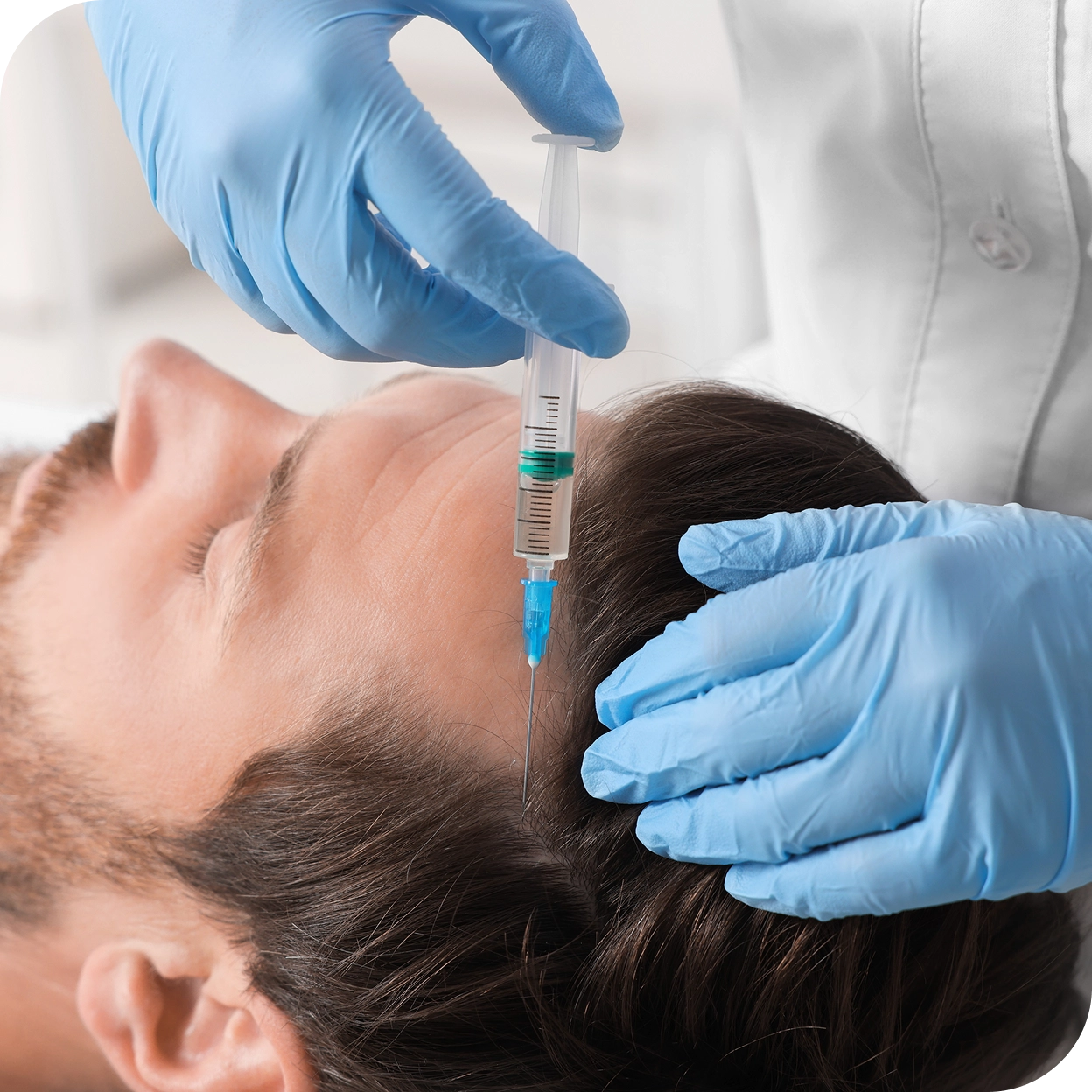
- Polynucleotides are introduced into the scalp with fine needles.
- The treatment takes place over several sessions. The number and intervals are tailored to your individual findings.
Why Polynucleotides for Hair Growth with Us?

Expert classification of hair loss
We examine the hair and scalp and narrow down the cause. There are differences between hereditary, diffuse and inflammation-related hair loss.

Experienced Doctors
A reliable diagnosis is the basis for effective and targeted treatment. Our specialists have extensive expertise in the dermatological diagnosis of hair and scalp conditions.

Modern Treatment Methods
In addition to regenerative approaches such as polynucleotides, we have various modern procedures available for treating hair loss. Combinations may be suitable depending on the cause.

Individual Consultation
Hair loss is complex in its cause, its severity and its development. We take all aspects into account, above all your personal expectations of the treatment result.
Procedure
Initial consultation & diagnosis
We would like to know when you started losing hair, how the hair loss has developed and whether you have any other complaints. We then examine the scalp, hair structure and the distribution of the hair loss.
Individual treatment planning
We clarify whether treatment with polynucleotides is useful in your situation. We then plan treatment intervals and possible combinations.
Treatment & support
The polynucleotides are injected with fine needles at small intervals into areas where hair density has already visibly declined.
Follow-up & adjustment
Hair growth takes time. A growth phase extends over several weeks. We arrange follow-up appointments and look at how hair density and hair thickness are developing and whether we need to adjust the treatment concept.
Specialist experience with polynucleotides for hair growth
Hair loss can have many different causes. With androgenetic hair loss, the hair follicles become smaller over time, while diffuse hair loss can have various other triggers. Polynucleotides are useful when sufficient active hair follicles are present.
Dr. med. univ. Martina Tröbinger is a specialist in dermatology and venereology FMH. Together with you, she clarifies the cause of the hair loss and which dermatological and regenerative treatment options are suitable for your findings.

What you can expect from us
Long-term support
Changes in hair growth only appear slowly and after several weeks at the earliest. We monitor progress over several months and adjust the treatment if necessary.
Medicine and skin therapy under one roof
The scalp and hair follicles form a unit. Scalp problems can have a direct effect on hair growth. The most effective therapy is therefore always a holistic one.
State-of-the-art therapies on site
The treatment of hair loss is one of our areas of focus at Derma Medical Clinic. Depending on the cause, dermatological and regenerative approaches are possible, often in combination.
More than just skin
Hormones, medication, illnesses or deficiencies can affect hair growth. Sometimes there is a genetic predisposition to hair loss. Our specialists take all factors into account and arrange further examinations if necessary.
What patients say about our treatment
Have hair loss and thinning hair assessed at an early stage.
We advise you on polynucleotides and other modern treatments.
FAQ
Frequently Asked Questions About Polynucleotides for Hair Growth
What are polynucleotides and how are they used against hair loss?
Polynucleotides are natural proteins made up of DNA building blocks. To treat the scalp and hair follicles, they are medically prepared and introduced into the scalp. In the area of the hair roots, they are intended to promote regenerative processes and strengthen hair growth in the long term. Several sessions are required.
Which form of hair loss are polynucleotides suitable for?
At Derma Medical Clinic in Zurich, we use polynucleotides primarily for androgenetic hair loss, i.e. hereditary thinning hair. With this form of hair loss, the hair follicles become increasingly smaller and the regrowing hair finer. Polynucleotide injections can demonstrably improve hair density and hair diameter.
Do polynucleotides help with diffuse hair loss?
With diffuse hair loss, the focus is on finding the trigger. Possible causes include hormonal changes, illnesses, medication, psychological triggers or nutrient deficiencies. Once we know the cause, we plan the appropriate treatment together.
How many treatments are required?
Treatment with polynucleotides is usually carried out as a series. The number and interval of the sessions depend on the findings and the individual progress.
When can I expect to see a change?
Hair grows slowly. To assess the result, it always takes several weeks to months. Clearly visible changes in hair thickness and hair density develop over the course of several months.
Can bald patches grow hair again completely?
One requirement for successful treatment is sufficient vital hair follicles. In cases of very advanced hair loss, the possibilities of a regenerative injection treatment are limited. The earlier an examination takes place when hair density declines, the sooner we can start a promising therapy.
Can polynucleotides be combined with PRP?
Polynucleotides and PRP are both regenerative treatment approaches for hair loss. Depending on the findings, both treatments can be combined, usually alternately and several weeks apart.
Is the treatment painful?
You will feel the injections as brief pricks on the scalp. They are generally not really painful. We use very fine needles and need a few seconds at most per injection. You can return to work immediately after the treatment.
What side effects can occur?
Redness, slight swelling, tenderness or small bruises are possible around the injection sites. Other side effects are very rare, and overall the treatment with polynucleotides is well tolerated, including on sensitive skin and a sensitive scalp.